 First 5 Notes
Bells Note Chart
Every note from low G to high C (written G4 to C6). 18 notes, each with its staff notation and the bar to strike. Free to view, no sign-in.
New players: start with the five notes marked First 5.
Notes are shown as written for bells. Glockenspiel sounds two octaves higher than written.
Every note from low G to high C (written G4 to C6). 18 notes, each with its staff notation and the bar to strike. Free to view, no sign-in. Notes are shown as written for bells. Glockenspiel sounds two octaves higher than written.
Teachers: you may print and copy this chart for your students.
Pick any note, play it, and the page tells you if you got it. Nothing is recorded.
How to read the chart
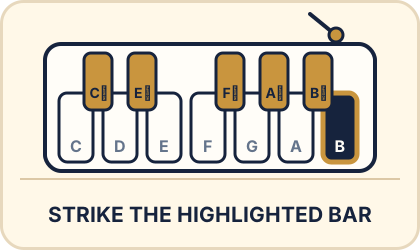
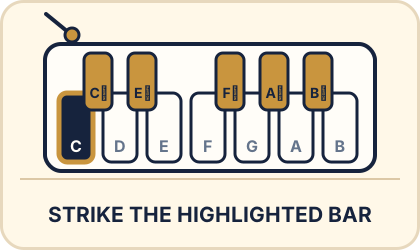
- The dark bar is the one to strike.
- Notes marked First 5 are the five the learning path starts with.
The dark bar is the one to strike. Notes marked First 5 are the five the learning path starts with.
Bells notes, low to high
G4
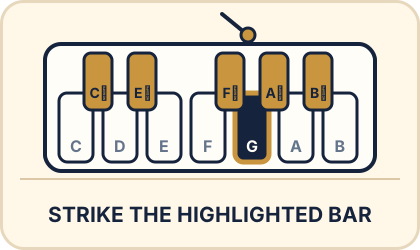

G bar - lower row
Check itStep by step
- Lower row, two bars left of the B♭ area.
A♭4
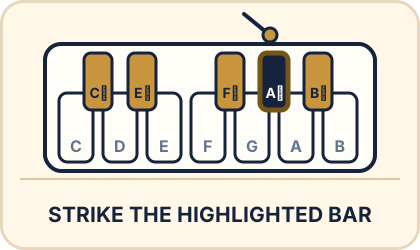

A♭ bar - upper row
A-flat 4. Also written G♯4 (G-sharp 4).
Check itStep by step
- Upper row, between the G and A bars.
A4
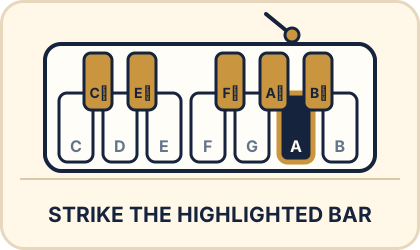

A bar - lower row
Check itStep by step
- Lower row, just left of B♭.
B♭4
First 5
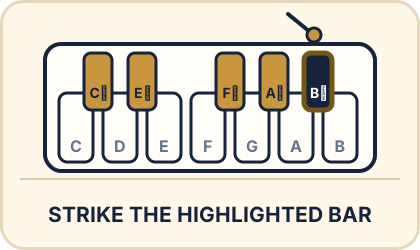

B♭ bar - upper row
B-flat 4. Also written A♯4 (A-sharp 4).
Check itStep by step
- Find the UPPER row of bars (the shorter, raised row).
- B♭ sits between the A and B bars of the lower row.
- Strike the middle of the bar with a relaxed bounce.
B4
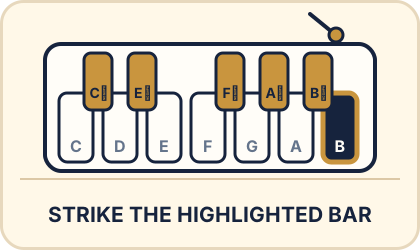

B bar - lower row
Check itStep by step
- Lower row - the B natural bar, NOT the raised B♭.
C5
First 5
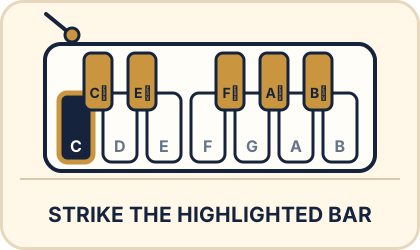

C bar - lower row
Check itStep by step
- Lower row of bars. Many instruments label the C bars.
- Strike the middle of the bar with a relaxed bounce.
C♯5
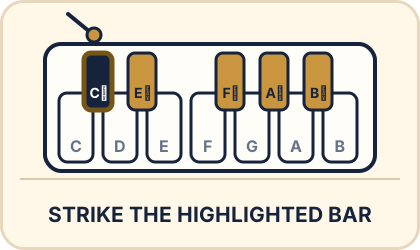

C♯ bar - upper row
C-sharp 5. Also written D♭5 (D-flat 5).
Check itStep by step
- Upper row, between the C and D bars.
D5
First 5
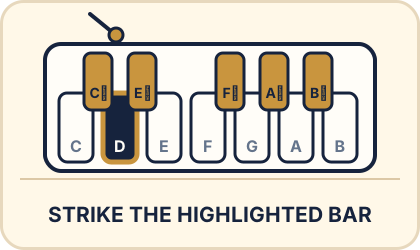

D bar - lower row
Check itStep by step
- Lower row, one bar to the right of C.
E♭5
First 5
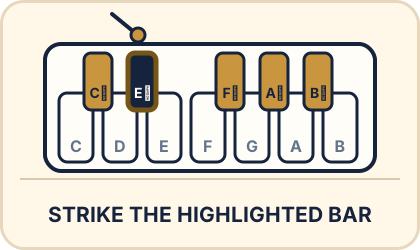

E♭ bar - upper row
E-flat 5. Also written D♯5 (D-sharp 5).
Check itStep by step
- Upper row. E♭ sits between the D and E bars of the lower row.
E5
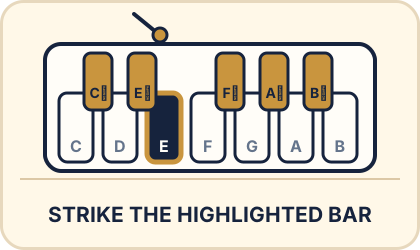

E bar - lower row
Check itStep by step
- Lower row, between the D and F bars.
F5
First 5
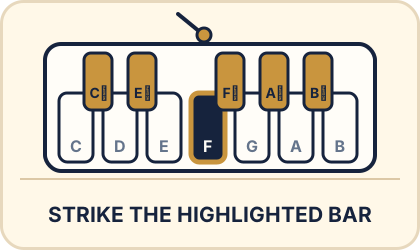

F bar - lower row
Check itStep by step
- Lower row, two bars right of D (after E).
F♯5
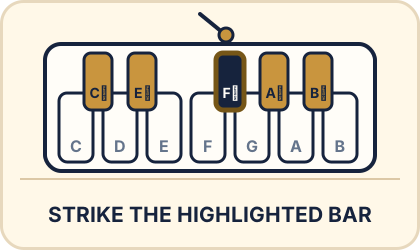

F♯ bar - upper row
F-sharp 5. Also written G♭5 (G-flat 5).
Check itStep by step
- Upper row, between the F and G bars.
G5
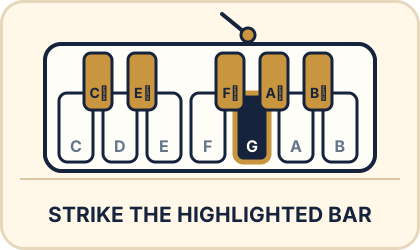
G bar - lower row
Check itStep by step
- Lower row - the next G up the keyboard.
A♭5
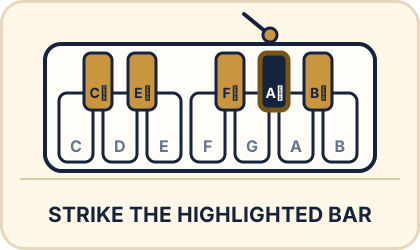
A♭ bar - upper row
A-flat 5. Also written G♯5 (G-sharp 5).
Check itStep by step
- Upper row, between G and A.
A5
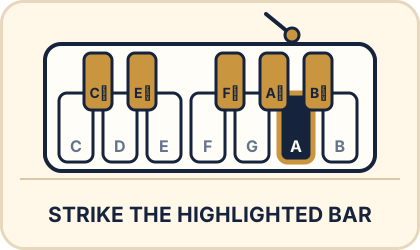
A bar - lower row
Check itStep by step
- Lower row, just left of B♭.
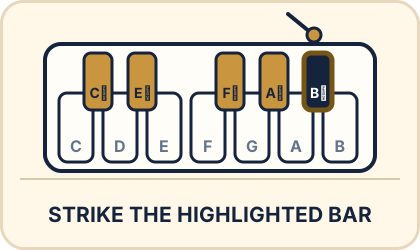
Practice these notes
The bells learning path takes these notes a few at a time: name the note, find the bar, then play it into the microphone. The first five notes are free to practice, with no account. The microphone only listens while you play, and nothing is recorded.
Start the bells learning pathMore charts
- Alto Saxophone fingering chart
- Baritone (Bass Clef) fingering chart
- Baritone (Treble Clef) fingering chart
- Baritone Saxophone fingering chart
- Bass Clarinet fingering chart
- Bassoon fingering chart
- Bells (Low Octave) note chart
- Clarinet fingering chart
- Flute fingering chart
- French Horn fingering chart
- Oboe fingering chart
- Tenor Saxophone fingering chart
- Trombone slide position chart
- Trumpet fingering chart
- Tuba fingering chart